
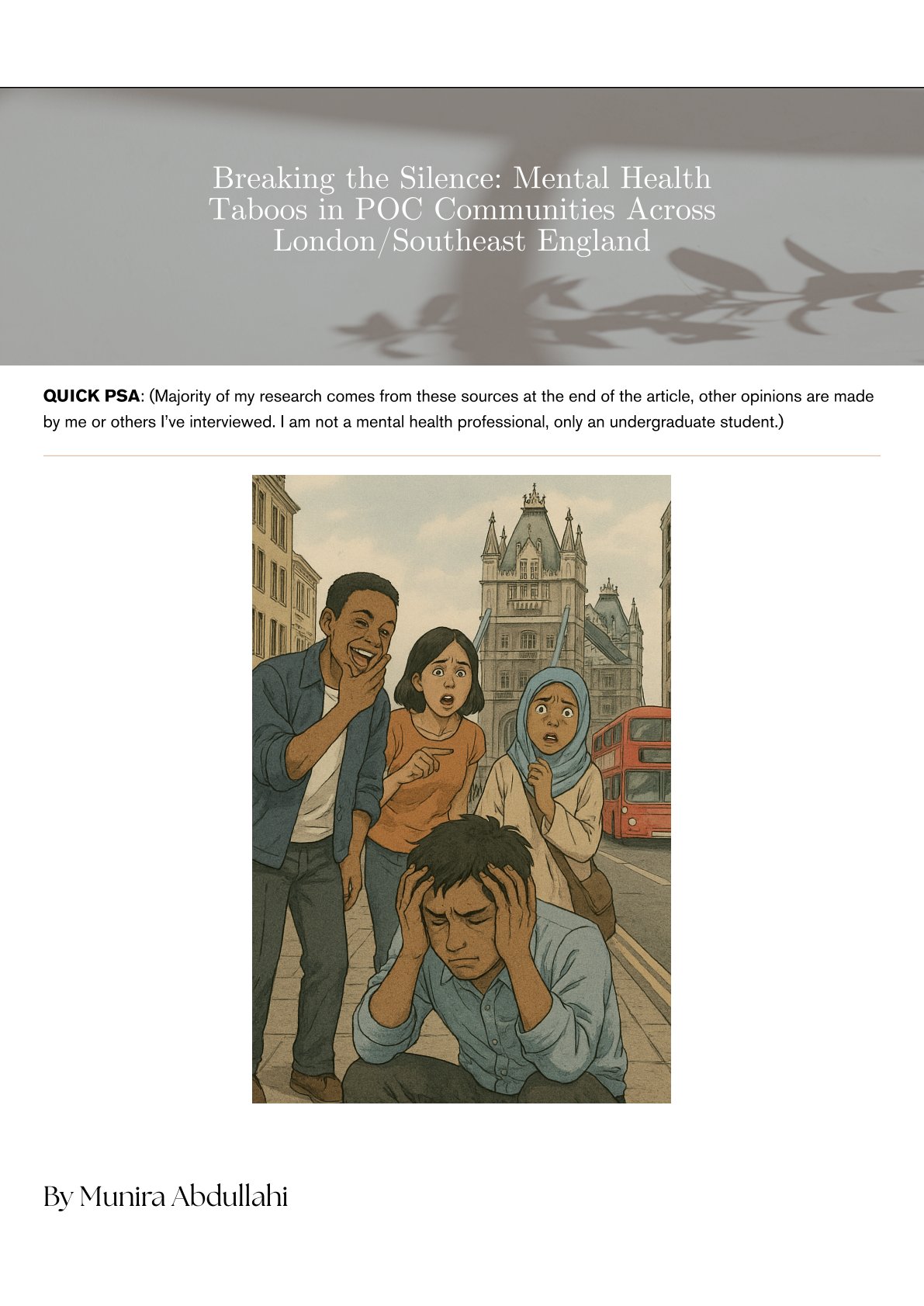
Breaking the Silence: Mental Health Taboo in POC Communities Across London & Southeast England
The stigma around mental health in communities of colour is prevalent worldwide. However, this article focuses specifically on those who reside in London and other parts of Southeast England. People of colour face unique cultural, historical and systemic barriers that affect their ideas around taking care of their mental health. In order to understand why this is the case, we must dive deeper into finding out the true cause of their distance for mental health, counselling & therapy.
Historical Roots of Stigma
While people of colour, are often treated as a homogeneous group, their views on mental health support vary widely, some welcome counselling, while others firmly oppose it. Much of this latter group stems from deep-seated mistrust rooted in historical medical discrimination. In the UK, Black individuals are about 3.5 times more likely to be detained under the Mental Health Act compared to White individuals (228 vs. 64 detentions per 100,000) (ethnicity-facts-figures.service.gov.uk). They are also over eight times more likely to face restrictive community treatment orders (mind.org.uk).
These disparities reflect a recurring pattern: Black and minority ethnic service users are more likely to enter the system via crisis or compulsory pathways, rather than voluntary, early support (pmc.ncbi.nlm.nih.gov, link.springer.com). Research continues to show that Black British patients are disproportionately diagnosed with severe mental illnesses like schizophrenia, often inaccurately while signs of mood disorders go overlooked (ojs.uwindsor.ca).
Together, these systemic failures reinforce a narrative in many BAME communities: mental healthcare is unsafe, unfair, or inaccessible. Black people, in particular, bear the brunt of misdiagnosis and coercive treatment, shaping a justified reluctance to engage with services. To rebuild trust, UK mental health services must adopt culturally competent, anti-racist approaches, including earlier outreach, representative workforce, and thorough attention to how racism, migration, and social adversity influence mental wellbeing.
Cultural Barriers and Community Expectations
Cultural factors play a significant role in maintaining mental health taboos within people of colour. In some Asian cultures, seeking professional help for mental health contradicts their values which align to good emotional control. Simran who is a Londoner of Indian origin states that “people are more likely to go to a religious figure to mention their problems to rather than the traditional route of therapy, for some people that works but for the ones that it doesn’t they feel isolated.” Maryam, a Londoner who is of Sri-Lankan descent shares similar beliefs as she sees that “Asian people tend to avoid getting diagnosed/reaching out for help as it’s looked down upon by others in the community. For them the opinions of others matter more than taking care of their mental health. Others from the community may also decide to only find ways to cope through religion and prayer which is great, however therapy would be a great addition to that also.”

Ideas like this are also prevalent in other ethnic communities. Being of Somali descent, mental health is seen as taboo, mental health is not a topic that is spoken about and is often stigmatised.
Kezia, who is a Londoner of Trinidadian origin, states that “in my community mental health isn’t really spoken about because of the stigma around it. If you tell most of the adults that you are feeling depressed or stressed, they will tell you that’s impossible because you are too young. They don’t understand that anyone can have those feelings despite their age.”
Systemic Barriers in London’s Mental Health Services
The mental health framework in London is not tailored to the particular needs of POC communities. Lack of cultural competency among mental health practitioners and lack of diversity among practitioners are significant barriers to effective care.
The mental health framework in London is not tailored to the particular needs of POC communities. Lack of cultural competency among mental health practitioners and lack of diversity among practitioners are significant barriers to effective care. The majority of those who access help are faced with practitioners who are unaware of their cultural backgrounds, religious beliefs, or racist experiences. This typically leads to misdiagnosis or improper treatment due to the embracement of a one-size-fits-all approach that ignores the impact of racism and cultural identity.
On the other hand, services like The AM to PM Wellbeing Service are here to actively challenge these inequalities. They put people first, making sure every client feels heard, understood, and supported in a way that respects their unique background and life experiences. With a diverse and inclusive team, they truly get how identity, trauma, and mental health are all connected, helping to build trust and offer care that feels not just accurate, but genuinely compassionate. Unlike contrast mainstream models which too often engage with POC communities at points of crisis, AM to PM promotes early intervention, community engagement, and therapeutic provision tailored to the unique issues of minority communities. As University College London and Anna Freud research indicates Black, mixed-heritage, and Asian young people are disproportionately referred through social care or youth justice, AM to PM’s model is a critical solution, providing accessible, proactive provision to prevent crisis and promote long-term wellbeing.
Conclusion
Shattering the stigma around mental illness involves an embrace of valid grievances that have caused growing distrust and creating new avenues to culturally competent care. Mental health care can be more available, more effective, and fairer with collaborating with POC communities. Not only is our mission to encourage more individuals to take advantage of care that exists within systems, but to change systems to be capable of embracing more diverse populations of individuals who live in London.
The pursuit of mental parity is a long-standing endeavour of doctors, activists from communities, policymakers, and citizens. Only as a group will we strive to eliminate stigmas concerning so many more accessing needed psychiatric treatments.
Sources
-University College London. “People of Colour (POC) students.” November 8, 2024. https://www.ucl.ac.uk/students/support-and-wellbeing-services/additional-information/specific-student-groups/people-colour-poc
-https://pmc.ncbi.nlm.nih.gov/articles/PMC9746991/